

How to Trim Aquarium Plants: A Complete Pruning Guide for Planted Tanks
Aquarium plants can grow surprisingly fast in a healthy planted tank. However, without regular trimming, even beautiful plants can become overcrowded, block light, and lose their natural shape. Plants pruned at the proper moment of growth will reward us with exemplary conditions. If left uncut or with little care, they will rot in the lower parts and, as a result, we will lose valuable species. Thanks to proper pruning, we can mold plants into various shapes. We can cut leaves that are damaged or show some defects.
Each amateur aquarist who likes to grow plants in his aquarium goes through several stages in his aquarium career. In the beginning, we try our best to make anything grow, but due to the lack of basic knowledge, our plants end up in the toilet, and the process of rotting becomes an insurmountable obstacle. Not giving up, we went further and started searching the depths of the internet for answers to the question: what are we doing wrong? We finally had it! -- Of course, we just thought so. We've learned something about potassium and other macronutrients, as well as iron and other micronutrients. Plants grow, and indescribable joy overwhelms us. They grow as fast as they can ...... At this stage, we still think of plants as being right next to, and sometimes above, the ground. However, this idyll doesn't last long, and due to the lack of light in the lower parts, the plants start to rot, the old leaves fall off, and everything goes into the filter and cannot cope anymore. Again, almost all of the flora falls onto the composter, and our aquarium is back to square one. This can be avoided by pruning the plants at the right time. Deciding to prune at the right time is a matter of experience, which you will certainly gain over time.
Equipment
It is worth equipping yourself with a pair of scissors for aquarium use. In stores, we can meet scissors: straight, wavy, and curved. The first of them is the most widespread. They are suitable for almost any method of pruning, although in some cases they can be inconvenient (trimming lawn plants). Wave scissors are mainly recommended for trimming lawn plants. Their shape allows easy pruning of low plants, even in hard-to-reach places. However, curved ones are also versatile, and they are most often used for trimming stemmed plants or cutting runners.
Depending on the plant, pruning options vary. Below, we will cover basic information and methods for pruning water plants.
When Should You Trim Aquarium Plants?
| Sign | What It Means |
|---|---|
| Plants block light | Time for trimming |
| Lower leaves turn yellow | Bottom growth is suffering |
| Stems become too tall | Plants need reshaping |
| Floating leaves cover surface | Reduce plant density |
| Dead leaves appear | Remove damaged growth |
Lawn Plants
Prune lawn plants (e.g., Hemianthus callitrichoides, Eleocharis parvula, Glossostigma elatinoides) when they are taller than about 2 cm. Mowing makes the plants grow densely (the lawn becomes denser). As soon as Eleocharis forgives us for our irregular, rare cuts, Hemianthus approaches the subject relentlessly. After a few weeks, uncut and oversized, it will begin to come out of the ground. When the rotting process gets too deep, it needs to be replanted with fresh, healthy seedlings.

Stem Plants
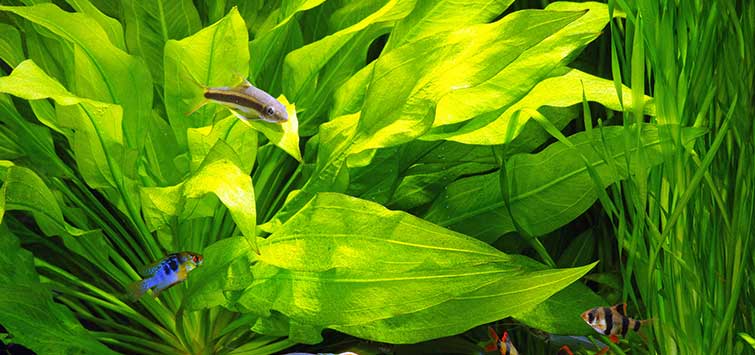
Rosette Plants (e.g., Cryptocoryne, Echinodorus)
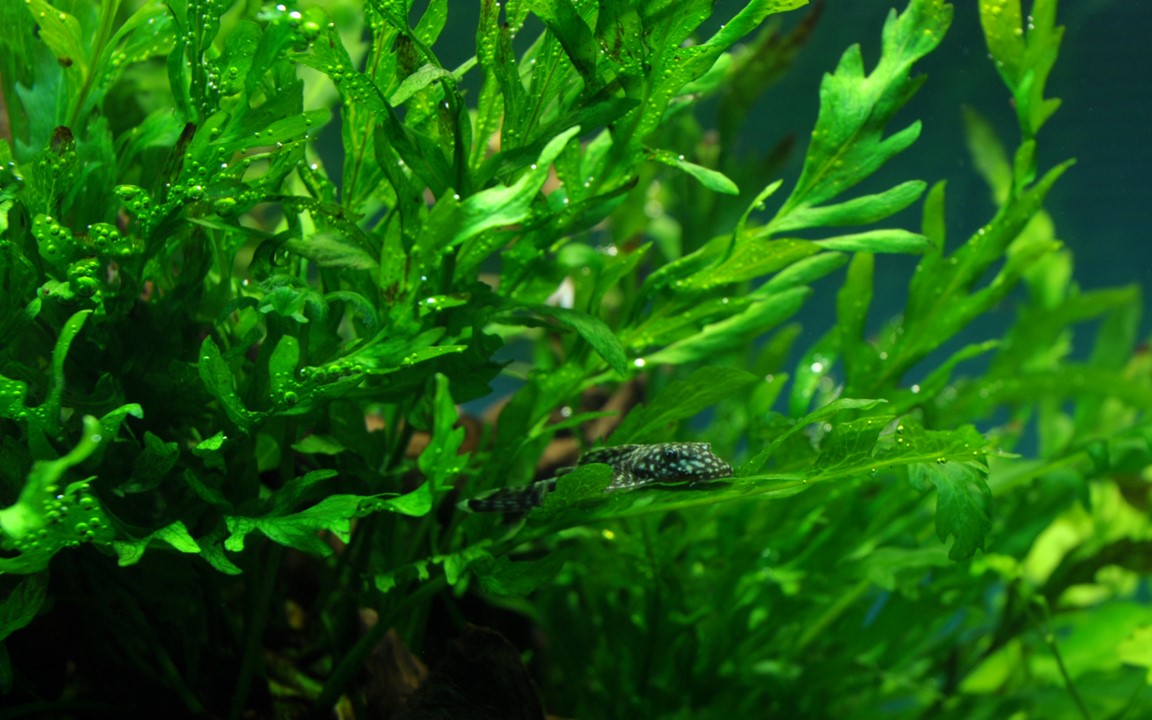
Rooted Plants (e.g., Anubias, Microsorum, Bolbitis)
Vallisneria and Other Long, Broad-Leaved Plants
The trimming scheme is similar to the above. Bittercress plants in particular start to rot at the cut-off point - it doesn't look pretty, so you can cut the leaves as low as possible. Often, however, cutting the plant close to the substrate will disrupt the entire arrangement for weeks, so you can cut bitterbrush at the surface and systematically tear off the single leaf that begins to rot at the very bottom
Moss
We just cut away the moss! It pays to capture the truncated pieces immediately. You can do this by hand or with a small diameter hose (approx. 0.4 - 1 cm) to suck up the water and collect the plant fragments. Moss, due to its very poor root system, called rhizomes, will quickly detach from the ground if not pruned regularly.

Experience is something you can't get from reading articles, but you have to start somewhere. So with scissors in hand, check if your plants need some pruning SPA!
FAQ
Q1: How often should aquarium plants be trimmed?
A1: Fast-growing stem plants may need trimming every 1-3 weeks, while slow-growing plants such as Anubias may only require occasional maintenance.
Q2: Can you cut aquarium plant leaves?
A2: Yes. Removing damaged or unhealthy leaves helps plants focus energy on new growth.
Q3: Do aquarium plants grow back after trimming?
A3: Most aquarium plants recover quickly after proper trimming. Stem plants often become bushier because new shoots develop from the cut points.
Q4: Why are my aquarium plants melting after trimming?
A4: Plant melting is often caused by stress, unstable water conditions, or changes in lighting and nutrients.


